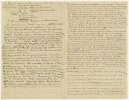
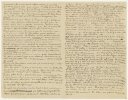
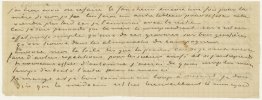
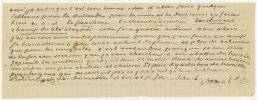
1r:1
My dear brother,
Although I’ve already written to you, there are still many things you have told me and to which I haven’t yet replied. First that you’ve rented a room in
Tanguy’s house and that my canvases are there, that’s most interesting – provided you’re not paying a lot for it
1 – the expenses still continuing and the canvases still taking their time to bring anything back in, that often frightens me.
Be that as it may, I think it’s a very good step, and I thank you for it, as for so many other things. It’s curious that
Maus has the idea of inviting young
Bernard and me for the next Vingtistes exhibition, I would really like to exhibit there, while feeling my inferiority alongside so many Belgians who have an enormous amount of talent. That
Mellery, for instance, is a great artist. And he’s also been holding up for a number of years now. But I would do my best to try to do something good this autumn. I’m working non-stop in my room, which is doing me good and driving away, I imagine, these abnormal ideas.
Thus I’ve redone the canvas of the Bedroom.
2 That study is certainly one of the best – sooner or later it will definitely have to be
lined. It was painted so quickly and dried in such a way that, as the thinner evaporated immediately, the painting doesn’t adhere at all firmly to the canvas.
3 This will also be the case with other studies of mine that were painted very quickly and with a thick impasto. Besides, this thin canvas perishes after a while and can’t take a lot of impasto.
You’ve taken some excellent stretching frames, damn it, if I had some like that here to work on that would be better than these strips of wood from here that warp in the sun.
People say – and I’m quite willing to believe it – that it’s difficult to know oneself – but it’s not easy to paint oneself either. Thus I’m working on two portraits of myself at the moment – for want of another model –
1v:2 because it’s more than time that I did a bit of figure work. One I began the first day I got up, I was thin, pale as a devil. It’s dark violet blue and the head whiteish with yellow hair, thus a colour effect.
4But since then I’ve started another one, three-quarter length on a light background.
5Then I’m retouching some studies from this summer – anyway I’m working from morning till night.
Are you well – darn it, I really wish for you that you were 2 years further on, and that these early days of marriage, however beautiful they may be at times, were behind you. I believe so firmly that a marriage becomes good above all in the long run, and that then one recovers one’s temperament. So take things with a certain northern phlegm and take care of yourselves, both of you. This bloody life in the fine arts is exhausting, so it seems.
Strength is coming back to me day by day, and once again it seems to me that I already have almost too much of it. For to remain hard-working at the easel it isn’t necessary to be a Hercules.
What you told me about
Maus having been to see my canvases has made me think a lot about Belgian painters lately and during my illness. Then memories come to me like an avalanche, and I try to rebuild for myself that whole school of modern Flemish artists to the point of being as homesick as a Swiss.
6Which isn’t good, for our path is – onward – and retracing one’s steps is forbidden and impossible. That’s to say that one could think about it without getting lost in the past through an over-melancholy nostalgia.
1v:3 Anyway,
Henri Conscience isn’t a perfect writer at all, but here and there, more or less everywhere, what a painter! And what kindness in what he said and wished for. All the time I have a preface in my head – (the one to Le conscrit) to one of his books in which he says that he’d been very ill and that in his illness, despite all his efforts, he had felt his affection for mankind withering away, and that long walks out in the open fields brought his feelings of love back to him.
7This inevitability of suffering and despair – anyway, here I am again, recovered for a period – I’m thankful for it.
I’m writing you this letter bit by bit in intervals when I’m tired of painting. Work is going quite well – I’m struggling with a canvas begun a few days before my indisposition. A reaper, the study is all yellow, terribly thickly impasted, but the subject was beautiful and simple.
8 I then saw in this reaper – a vague figure struggling like a devil in the full heat of the day to reach the end of his toil – I then saw the image of death in it, in this sense that humanity would be the wheat being reaped. So if you like it’s the opposite of that Sower I tried before.
9 But in this death nothing sad, it takes place in broad daylight with a sun that floods everything with a light of fine gold. Good, here I am again, however I’m not letting go, and I’m trying again on a new canvas.
10 Ah, I could almost believe that I have a new period of clarity ahead of me.
And what should I do – continue here for these months, or move – I don’t know. The thing is, when the crises present themselves they aren’t amusing, and to risk having an attack like that with you or others is serious.
1r:4 My dear brother – I’m still writing to you between bouts of work – I’m ploughing on like a man possessed, more than ever I have a pent-up fury for work, and I think that this will contribute to curing me.
Perhaps something will happen to me like the thing
E. Delacroix speaks of – “I found painting when I had neither teeth nor breath left”,
11 in this sense that my sad illness makes me work with a pent-up fury – very slowly – but from morning till night without respite – and –
this is probably the secret – work for a long time and slowly. What do I know about it, but I think that I have one or two canvases on the go that aren’t too bad, first the reaper in the yellow wheat, and the portrait on a light background. This will be for the Vingtistes, if indeed they remember me when the time comes. Now, it would be absolutely the same to me, if not preferable, if they forget me.
Since I myself don’t forget the inspiration that I gain from giving free rein to my memories of certain Belgians. That’s the positive thing, and the rest is so secondary.
And here we are in September already, we’ll soon be in the middle of autumn, and then winter.
I’ll carry on working very hard, and then if the crisis returns towards Christmas we’ll see, and once that’s over then I wouldn’t see any disadvantage in sending the management here to all the devils and coming back to the north for a fairly long time. Leaving now would perhaps be too unwise, when I consider a new crisis likely in the winter, i.e. in 3 months.
I haven’t set a foot outside for 6 weeks, not even in the garden.
I’ll try, though, next week, when I’ve finished the canvases in progress.
But another few months and I’ll be so flabby and stupefied that a change will probably do a lot of good.
That, for the moment, is my idea on the subject, of course it isn’t a fixed idea.
But am of the opinion that we shouldn’t put ourselves out any more with the people of this establishment than with the owners of a hotel. We’ve rented a room from them for a certain amount of time, and they’re well paid for what they give, and that’s absolutely all.
Not to mention the fact that perhaps they’d like nothing better than for the situation to be chronic, and one would be culpably stupid if one gave in to them on that.
For my taste, they make far too many enquiries about not only what I but you earn &c.
So let’s give them the slip. Without quarrelling.
2r:5 I’m still continuing this letter between times. Yesterday I began the portrait of the
chief orderly, and perhaps I’ll also do his
wife, for he’s married and lives in a little farmhouse a stone’s throw from the establishment.
12A most interesting figure. There’s a beautiful etching by
Legros of an old Spanish nobleman, if you remember it that will give you an idea of the type.
13 He was at the hospital in Marseille during 2 episodes of cholera,
14 anyway he’s a man who has seen an enormous number of people die and suffer, and there’s an indefinable contemplation in his face, such that I can’t help recalling the face of
Guizot – for there’s something of that one in this head – but different. But he’s a man of the people, and simpler. Anyway, you’ll see it if I succeed in it and if I do a repetition of it.
I’m struggling with all my energy to master my work, telling myself that if I win this it will be the best lightning conductor for the illness. I take great care of myself by carefully shutting myself away; it’s selfish if you like, not to become accustomed to my companions in misfortune here instead, and to go to see them, but anyway I feel none the worse for it, for my work is progressing and we have need of that, for it’s more than necessary that I do better than before, which wasn’t sufficient.
Isn’t it better that if I were to come back from here again, sooner or later, I come back decidedly capable of doing a portrait that has some character, than to come back as I left? It’s coarsely expressed, for I really feel that one can’t say ‘I can do a portrait’ without telling a lie, because that is infinite. But anyway you’ll understand what I want to say, that I must do better than before.
At the moment my mind is functioning regularly and I feel absolutely normal – and if I think rationally at present about my condition with the hope of having in general between the crises – if, unfortunately, it’s to be feared that this will always recur from time to time – of having periods of clarity and work between times – if I think rationally
2v:6 at present about my condition then certainly I tell myself that I mustn’t have the
idée fixe of being ill. But that I must continue my little career as a painter firmly. To remain for good in an asylum from now on would probably be exaggerating things.
I was reading in Le Figaro a few days ago a story of a
Russian writer who lived with a nervous illness from which he, moreover, sadly died, which caused him terrible attacks from time to time.
And what can one do, there’s no remedy, or if there is it’s to work passionately.
15 I dwell on that more than I should. And all in all I
prefer to have a proper illness like this than to be as I was in Paris when it was brewing.
Also you’ll see this when you put the portrait with the light background which I’ve just finished beside those I did of myself in Paris, that
at present I look healthier than then, and even a great deal more so.
16 I’m even inclined to believe that the portrait will tell you better than my letter how I am, and that it will reassure you – it cost me some trouble.
And then the reaper is working too I think – it’s very, very simple.
At the end of the month you can rely on 12 no. 30 canvases I dare say,
17 but there will be almost the same ones twice, the study and the final painting.
18Anyway later – perhaps my journey into the south will bear fruit however, because the difference of the stronger light, the blue sky, that teaches one to see, and then above all and even only when one sees that for a long time.
The north will certainly appear completely new to me, but I’ve looked so much at the things that I’ve become strongly attached to them, and
2v:7 I’ll remain melancholy for a long time.
I’m thinking of a funny thing. Modern art is discussed in Manette Salomon, and some artist or other speaking of ‘what will remain’ says: what will remain are ‘the landscape artists’
19 – that had a grain of truth, because
Corot,
Daubigny,
Dupré,
Rousseau –
Millet as a landscape painter, that lasts, and when Corot says on his deathbed: in a dream I saw landscapes with completely pink skies, it was charming;
20 then – very good – in
Monet,
Pissarro,
Renoir we see those completely pink skies, so the landscape painters do last well, that was darned true. Let’s leave aside the figure painting of
Delacroix, of Millet.
Afterwards, what are we beginning to glimpse timidly at the moment that is original and lasting – the
portrait. That’s something old, one might say – but it’s also brand new. We’ll talk more about this – but let’s still continue to seek out portraits, above all of artists, like the
Guillaumin and Guillaumin’s portrait of a young girl,
21 and take good care of my portrait by
Russell, which means a lot to me.
22Have you framed the
Laval portrait, you haven’t told me what you thought of it I think, I found it marvellous, that gaze through the pince-nez, such an honest gaze.
23The will that I have to do portraits these days is terribly strong, anyway
Gauguin and I used to chat about that and about similar questions in such a way as to stretch our nerves to the extinction of all vital warmth.
But out of that, however, a few good paintings must emerge I dare think, and we’re seeking them and they must, I imagine, be doing good work in Brittany. I’ve received a letter from
G., I think I’ve already told you,
24 and I’m very curious to see what they’re doing one day.
2r:8 I must ask you for the following painting items.
| |
|
10 metres canvas |
| Large |
tubes |
6 |
tubes |
zinc white |
| ,, |
,, |
2 |
,, |
emerald green |
| |
|
2 |
,, |
cobalt |
| Small tubes |
|
|
|
| |
|
2 |
Carmine |
| |
|
1 |
vermilion |
| Large tube crimson lake |
| 6 fitch brushes,25 black hair. |
Then I’ve promised the orderly here an issue of Le Monde Illustré, Issue 1684, 6 July 1889, in which there’s a very pretty engraving after
Demont-Breton.
26Phew – the reaper is finished, I think it will be one that you’ll place in your home – it’s an image of death as the great book of nature
27 speaks to us about it – but what I sought is the ‘almost smiling’.
28 It’s all yellow except for a line of violet hills – a pale, blond yellow. I myself find that funny, that I saw it like that through the iron bars of a cell.
Ah well, do you know what I hope for once I set myself to having some hope, it’s that the family will be for you what nature is for me, the mounds of earth, the grass, the yellow wheat, the peasant. That’s to say that you find in your love for people the wherewithal
not only to work but the wherewithal to console you and restore you when one needs it. So please don’t let yourself be exhausted too much by business matters but take good care of yourselves, both of you – perhaps in a not-too-distant future there’s still some good.
3r:9 I really want to redo the reaper one more time for
Mother, if not I’ll make her another painting for her birthday,
29 that will come later, for I’ll send it with the rest.
For I’m sure that
Mother would understand it – for it’s indeed as simple as one of those coarse wood engravings that one finds in country almanacs.
Send me the canvas as soon as you can, because I want to do some more repetitions for the
sisters too, and if I undertake new autumnal effects I’ll have the wherewithal to fill my time from one end to the other for this month.
I’m eating and drinking like a wolf at present. I must say that the
doctor30 is very kindly towards me.
3v:10 Yes, I think it’s a good idea to go and make a few paintings for Holland, for
Mother and the two
sisters that will make three, i.e. the
reaper, the
bedroom, the
olive trees,
wheatfield and cypress, that will make four even, for then I have yet another person for whom I’ll make one too.
31 I’ll work on that with as much pleasure and more calm than for the Vingtistes, that goes without saying, since I’m feeling strong you can be sure that I’m going to try to get through a lot of work. I’m taking the best there are from 12 subjects, so they’ll still have things that are a little studied and chosen. And then there is good in working for people who don’t know what a painting is.
Good handshake to you and Jo.
Ever yours,
Vincent
I’m opening this letter once more to tell you that I’ve just seen
Mr Peyron, I hadn’t seen him for 6 days. He tells me that he’s planning to go to Paris this month and that he’ll see you then. That gives me pleasure, for he has, there’s no doubt about it, a lot of experience, and I think he’ll tell you what he thinks of it quite frankly.
To me he only said – ‘let’s hope that it won’t recur’, but anyway I’m
counting on it recurring for quite a long time, for a few years at least. But I’m also counting on the fact that work, far from being impossible for me, can go along steadily in the meantime, and is even my remedy. And so I say once more – excluding
Mr Peyron the doctor absolutely – that as regards the management here we should probably be polite, but that we should limit ourselves to that but bind ourselves to nothing.
It’s very serious that wherever I were to stay here for a little longer I would perhaps come up against popular prejudices – I don’t even know what these prejudices are – which would make my life with them unbearable.
But anyway, I’m awaiting what
Mr Peyron will say to you, myself I have no idea what his opinion is. I worked this afternoon on the portrait of the orderly, which is progressing. If it weren’t very much tempered – completely – by an intelligent gaze and an expression of kindness – he would be a real bird of prey. He really is a southern type.
I’m curious if
Mr Peyron’s planned journey will indeed take place this time, I’m very curious to know what may come of it.
4v:12 With another year’s work, perhaps I’ll arrive at a feeling of self-security from the artistic point of view. And that’s always something worth seeking.
But for that I must have good luck. What I dream of in my best moments aren’t so much dazzling colour effects as the half-tones once again.
And certainly the visit to the Montpellier museum contributed to turning my thoughts in that direction. For what touched me there more than the
magnificent Courbets, which are marvels, the young ladies of the village, the sleeping spinner
32 – were the portraits of
Bruyas by
Delacroix and by
Ricard,
33 then the Daniel,
34 Delacroix’s odalisques, all in half-tones. For these odalisques are something quite different from those in the Louvre.
35 It’s above all purplish.
But in these half-tones what choice and what quality!
It’s time for me to send off this letter at last – I could tell you in two pages what it contains, i.e. nothing new. But anyway, I don’t have time to redo it.
Good handshake once again, and if it doesn’t put you out too much let me have the canvas as soon as possible.
4
Ever yours,
V.





![[2735]](/vg/interface/artworkref.png "Vincent van Gogh - The bedroom (F 482 / JH 1608) (Click to view image)")
![[2735]](/vg/illustrations/2735t.jpg "Vincent van Gogh - The bedroom (F 482 / JH 1608)")
![[3007]](/vg/illustrations/3007t.jpg "Vincent van Gogh - The bedroom (F 484 / JH 1771)")
![[2826]](/vg/illustrations/2826t.jpg "Vincent van Gogh - Self-portrait (F 626 / JH 1770)")
![[2827]](/vg/illustrations/2827t.jpg "Vincent van Gogh - Self-portrait (F 627 / JH 1772)")
![[2813]](/vg/illustrations/2813t.jpg "Vincent van Gogh - Reaper (F 617 / JH 1753)")
![[2746]](/vg/illustrations/2746t.jpg "Vincent van Gogh - Sower with setting sun (F 450 / JH 1627)")
![[2828]](/vg/illustrations/2828t.jpg "Vincent van Gogh - Reaper (F 618 / JH 1773)")
![[2829]](/vg/illustrations/2829t.jpg "Vincent van Gogh - Charles-Elzéard Trabuc (F 629 / JH 1774)")
![[1042]](/vg/illustrations/1042t.jpg "Alphonse Legros - The tall Spaniard")
![[2943]](/vg/illustrations/2943t.jpg "Vincent van Gogh - Self-portrait as a painter (F 522 / JH 1356)")
![[2816]](/vg/illustrations/2816t.jpg "Vincent van Gogh - Wheatfield and cypresses (F 717 / JH 1756)")
![[2815]](/vg/illustrations/2815t.jpg "Vincent van Gogh - Wheatfield and cypresses (F 615 / JH 1755)")
![[2292]](/vg/illustrations/2292t.jpg "Jean Baptiste Armand Guillaumin - Self-portrait with palette")
![[146]](/vg/illustrations/146t.jpg "Jean Baptiste Armand Guillaumin - Portrait of a young woman")
![[1310]](/vg/illustrations/1310t.jpg "John Peter Russell - Vincent van Gogh")
![[2247]](/vg/illustrations/2247t.jpg "Charles Laval - Self-portrait")
![[2293]](/vg/illustrations/2293t.jpg "Virginie Demont-Breton - The husband is at sea")
![[2844]](/vg/illustrations/2844t.jpg "Vincent van Gogh - Reaper (F 619 / JH 1792)")
![[729]](/vg/illustrations/729t.jpg "Gustave Courbet - Female bathers")
![[730]](/vg/illustrations/730t.jpg "Gustave Courbet - The sleeping spinner")
![[76]](/vg/illustrations/76t.jpg "Ferdinand Victor Eugène Delacroix - Alfred Bruyas")
![[1272]](/vg/illustrations/1272t.jpg "Louis Gustave Ricard - Alfred Bruyas")
![[67]](/vg/illustrations/67t.jpg "Ferdinand Victor Eugène Delacroix - Daniel in the lions’ den")
![[74]](/vg/illustrations/74t.jpg "Ferdinand Victor Eugène Delacroix - Algerian women in their apartments (The odalisques)")