1r:1
19 March.
My dear brother,
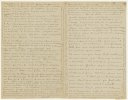
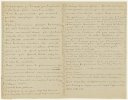
I seemed to see so much restrained brotherly anguish in your kind letter that it seems to me to be my duty to break my silence.
1 I write to you in full possession of my presence of mind and not like a madman but as the brother you know. Here is the truth: a certain number of people from here have addressed a petition (there were more than 80 signatures on it) to the mayor (I think his name is M.
Tardieu) designating me as a man not worthy of living at liberty, or something like that.
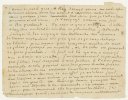
2The
chief of police or the chief inspector then gave the order to have me locked up once again.
3Anyway, here I am, shut up for long days under lock and key and with warders in the isolation cell, without my culpability being proven or even provable.
It goes without saying that in my heart of hearts I have a lot to say in reply to all that. It goes without saying that I shouldn’t get angry, and that apologizing would seem to me to be accusing myself in such a case.
Only to warn you: to free me – first I don’t ask it, being sure that all of this accusation will be reduced to nothing.
Only I say to you, you would find it difficult to free me. If I didn’t restrain my indignation I would immediately be judged to be a dangerous madman. In waiting let us hope, besides, strong emotions could only aggravate my state.
If in a month’s time, though, you have no direct news of me, then act, but as long as I’m writing to you, wait.
1v:2 That’s why I now ask you to promise to let them act without getting yourself mixed up in it.
Consider yourself warned that it would perhaps complicate and confuse the matter.
All the more so since you’ll understand that while I’m absolutely calm at the given moment, I may easily fall back into a state of over-excitement through new moral emotions.
So you can imagine how much of a hammer-blow full in the chest it was when I found out that there were so many people here who were cowardly enough to band themselves together against one man, and a sick one at that.
Good. That’s for your guidance; as regards my moral state, I’m badly shaken, but all the same I’m recovering a certain calm so as not to get angry. Besides, humility suits me after the experience of repeated attacks.
4So I’m being patient.
The main thing, I couldn’t say it too often, is that you should keep your calm too, and that nothing
1v:3 should disturb you in your affairs. After your marriage we can deal with sorting all this out, and in the meantime, my word, leave me here quietly. I’m convinced that Mr
Mayor, as well as the
chief of police, are more like friends and that they’ll do everything they can to settle all this. Here, except for freedom, except for lots of things that I would wish otherwise, I’m not too bad. Besides, I told them that we weren’t in a position to bear expenses. I can’t move without expenses,
5 now I haven’t been working for 3 months, and mind you, I would have been able to work if they hadn’t exasperated and bothered me.
How are
Mother and our
sister? Having nothing else to distract me – I’m even forbidden to smoke – which, however, the other patients are allowed to do. Having nothing else to do I think about all those I know all day and night long.
What misery – and all of it, so to speak, for nothing.
I won’t hide from you that I would have preferred to die than to cause and bear so much trouble. What can you say, to suffer without complaining is the only lesson that has to be learned in this life.
6
1r:4 Now, in all that, if I must resume my task of painting I naturally need my studio, the furniture, which we certainly can’t afford to renew if it’s lost.
To be reduced once again to living in the hotel, you know that my work won’t allow it, I must have a fixed pied-à-terre. If these fellows here protest against me, I protest against them, and they just have to provide me with damages and interest in a friendly way, in short they just have to give me back what I would lose by their fault and ignorance.
If – let’s say – I were to become definitively insane – certainly I don’t say that it’s impossible, in any case they should treat me differently, give me back the fresh air, my work &c.
Then – my word – I would resign myself. But we aren’t even there yet, and if I’d had my tranquillity I’d have been back on my feet long ago. They scold me about what I’ve smoked and drunk, fine.
7But what can you say, with all their sobriety they’re actually only giving me new miseries. My dear brother, the best thing remains perhaps to joke about our little miseries, and also a little about the great ones of human life.
8 Take it like a man and walk dead straight towards your goal. We artists in present-day society are no more than the broken pitcher. How I’d like to be able to send you my canvases, but everything is under lock and key, police and keepers of the insane. Don’t free me, it will settle itself on its own – all the same, warn
Signac that he shouldn’t get involved until I write again, for he’d be putting his hand into a wasps’ nest.
9 I shake your hand most cordially in thought, regards to your fiancée, to
Mother and our
sister.
Ever yours,
Vincent
I’ll read this letter as it stands to
Mr Rey, who isn’t responsible, having been ill himself – no doubt he’ll write to you himself too. My house has been shut up by the police.
I have a vague memory of a registered letter from you for which I was made to sign but which I didn’t want to accept because they were making such a fuss for the signature, and of which I’ve since had no more news.
Explain to
Bernard that I haven’t been able to reply to him, it’s quite a performance to write a letter: at least as many formalities are necessary as in prison now. Tell him to ask
Gauguin for advice, but shake his hand firmly from me.
I would have preferred not to write to you yet for fear of compromising you and disturbing you in what must work out above all. It will settle itself, it’s too idiotic to last.
When you move house, address please.
I had hoped that
Mr Rey would come to see me in order to talk with him before sending this letter, but although I had made it known that I was waiting for him, nobody came.
10 I urge you again to be cautious. You know what it is to go to the civil authorities to complain. Wait until your journey to Holland at least.
11I myself fear a little that if I go outside at liberty I wouldn’t always be master of myself if I was provoked or insulted, and one could take advantage of that. The fact remains that a petition was sent to the
mayor. I bluntly replied that I was entirely disposed to chuck myself into the water, for example, if that could make these virtuous fellows happy once and for all, but that in any case if in fact I had wounded myself I had done nothing of the sort to these people &c. So courage, then, although the guts fail me at times. Your coming here – my word – for the moment it would precipitate things. I’ll move house when I see the means naturally.
2v:6 I hope that this reaches you in good condition. Let’s not fear, I’m quite calm now. Leave them to their own devices. You will perhaps do well to write one more time, but nothing more for the moment. If I’m patient, that could only make me stronger so that I won’t be so much in danger of relapsing into a crisis. Naturally I who really have done my best to be friends with the people and didn’t suspect it, it has been a harsh blow to me.
More soon, I hope, my dear brother, don’t worry. It’s perhaps a sort of quarantine I’m being put through. What do I know?



![[2278]](/vg/interface/artworkref.png "- Petition to the mayor of Arles (Click to view image)")
![[2278]](/vg/illustrations/2278t.jpg "- Petition to the mayor of Arles")
![[2280]](/vg/illustrations/2280t.jpg "- Report by the chief of police, Joseph d’Ornano")